Types, techniques, and manufacturers — a working reference for the studio
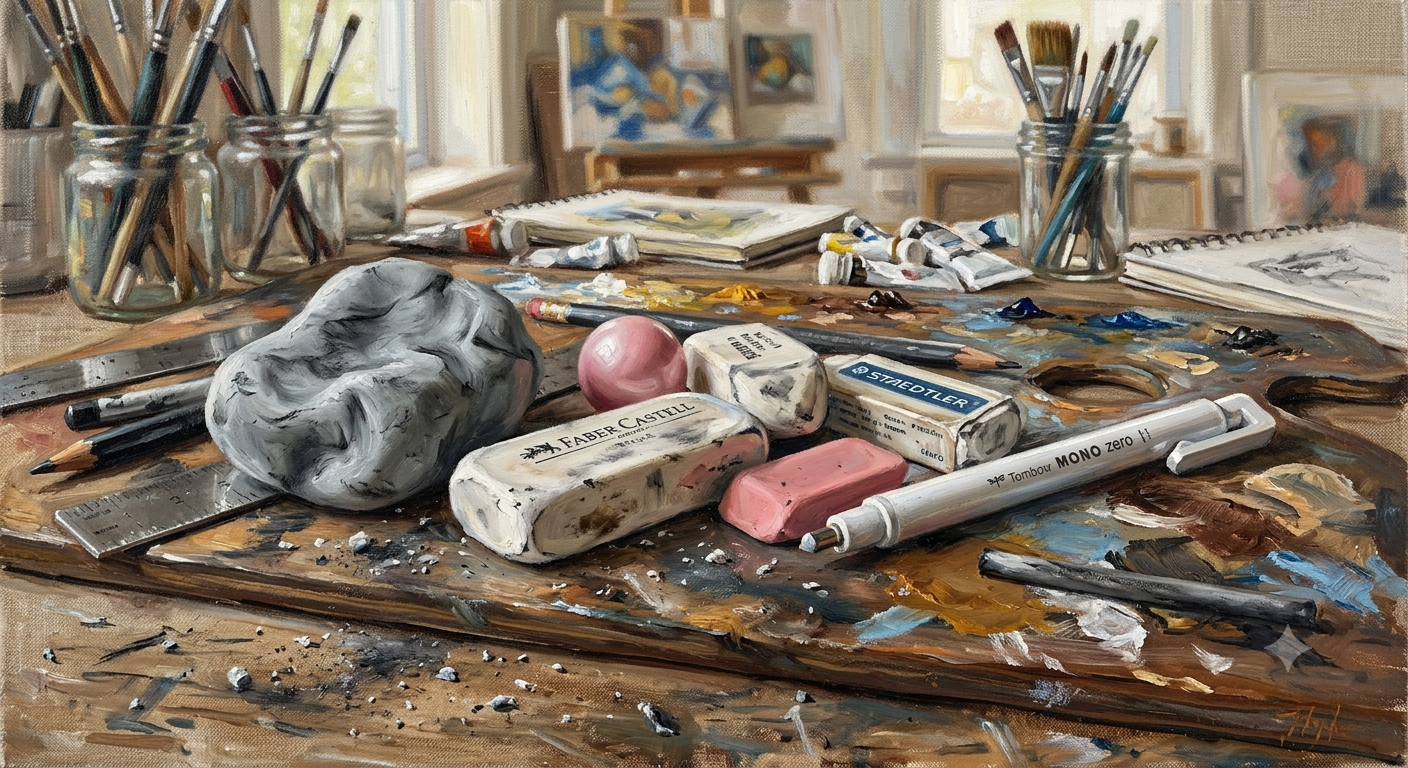
An eraser is not just an undo button — in the hands of a drawing artist it’s a drawing tool in its own right, used to lift highlights, soften edges, sharpen contrast, and rescue a life-drawing pose gone wrong in the last five minutes of a pose. Different erasers are built from very different materials (natural rubber, synthetic rubber, vinyl/PVC, foam, or abrasive compounds) and they behave very differently on paper as a result. This guide covers the main types in use today, what each one is actually good at, and the manufacturers most artists reach for.
How Erasing Actually Works
Every eraser removes marks by one of two basic mechanisms. Adhesive/lifting erasers (kneaded rubber, and to a lesser extent gum) are tacky enough that graphite or charcoal particles stick to the eraser’s surface and are pulled away from the paper — almost no abrasion of the paper fibres occurs. Abrasive/shedding erasers (rubber, vinyl, sand) work by mild friction: the eraser itself wears away in fine crumbs, and those crumbs carry the pigment off the page with them. This distinction is the reason a kneaded eraser can be pressed onto delicate paper without damage, while a vinyl eraser used too aggressively can burnish or tear the same sheet.
The Main Types of Erasers
Kneaded (Putty) Eraser
The sculptor’s eraser — soft, mouldable, and endlessly reusable.
| How it works | Adhesive lifting — press, twist, and pull away rather than rub. The material absorbs pigment as it’s used, and is refreshed by stretching and folding it back on itself (“kneading”) until the surface is clean grey again. |
| Best for | Graphite and charcoal on all but the most delicate papers; lifting soft highlights out of shading; picking out fine details by pressing a kneaded point into small areas; softening hard pencil lines during the block-in stage of a life drawing. |
| Use caution with | Colored pencil (it tends to just smear wax-based pigment rather than lift it); long unwashed hands can transfer skin oils into the eraser and then onto the paper. |
| Note | Called a “putty rubber” in the UK and much of Europe. Quality varies a lot between brands — some stay soft and workable for months, cheaper ones dry out and crumble. |
Rubber (Pink Pearl style) Eraser
The classic pencil-top eraser — firm, pink, and familiar to everyone.
| How it works | Abrasive/shedding — the eraser sheds fine crumbs as it rubs, and pigment is carried away with the crumbs. |
| Best for | General graphite erasing on ordinary drawing and layout paper; broad, everyday correction work where precision isn’t critical. |
| Use caution with | Soft or thin papers, which can tear under firm rubbing; charcoal and pastel, which it tends to smear rather than lift cleanly. |
| Note | Traditionally made from vulcanised natural or synthetic rubber with an abrasive filler (historically pumice); the pink colour itself has no functional purpose, it’s just the traditional dye. |
Gum (Art Gum) Eraser
A soft, crumbly block that’s gentle on delicate surfaces.
| How it works | Abrasive/shedding, but very softly so — it crumbles apart faster than a rubber eraser and carries pigment away in the crumbs with minimal friction on the paper itself. |
| Best for | Clearing graphite dust and smudges off large areas without damaging the paper surface; cleaning up around a finished drawing; light general-purpose erasing on textured or fragile paper. |
| Use caution with | Fine detail work — it crumbles too readily to erase a precise line; charcoal and pastel, which it can smear across the page. |
| Note | Traditionally called “art gum,” a trademarked term dating to the early 1900s; despite the name it’s a rubber-based product, not a plant gum. |
Vinyl / Plastic Eraser
The hardest-working eraser in the box — firm, precise, and thorough.
| How it works | Abrasive/shedding — made from PVC (or PVC-free elastomer in newer “green” formulations) which is harder than rubber, so it lifts pigment more completely but is less forgiving of the paper surface. |
| Best for | Complete removal of graphite, including hard, dense pencil marks; erasing ink and drafting film marks (some formulations); crisp, clean corrections where a kneaded or gum eraser leaves a faint ghost. |
| Use caution with | Soft or delicate papers, which a firm vinyl eraser can burnish, glaze, or tear if used with heavy pressure; use a light hand and let the eraser do the work. |
| Note | Also called a “plastic” or “drafting” eraser. The Staedtler Mars Plastic, introduced in 1967, essentially defined this category and remains the benchmark most other vinyl erasers are compared to. |
Sand / Abrasive Eraser
A rubber-and-grit eraser for the marks nothing else will shift.
| How it works | Pure abrasion — fine silica or pumice grit embedded in a rubber base sands the top layer of the paper away along with the pigment sitting on it. |
| Best for | Stubborn coloured pencil, ink, and marker residue; creating small bright highlights by abrading pigment off the paper’s top layer; spot-cleaning a small stain or smudge. |
| Use caution with | Almost any delicate or lightweight paper — the embedded grit is genuinely abrasive and will scuff or thin the surface if overused; keep it for small, targeted areas only. |
| Note | Best used sparingly and only in areas that will be reworked or covered, since the abraded paper surface takes pigment differently afterwards. |
Electric / Battery Eraser
A spinning eraser tip for pinpoint control and less hand fatigue.
| How it works | Abrasive/shedding, mechanised — a motor spins a thin vinyl or rubber tip at high speed so very little hand pressure is needed to lift pigment precisely. |
| Best for | Fine highlights (individual hair strands, catchlights in eyes); long, tedious erasing sessions where hand fatigue is a factor; precise correction inside tight linework. |
| Use caution with | Very soft or thin paper — the spinning tip can wear through a small spot quickly if held in one place too long; keep the eraser moving. |
| Note | Replacement tips are sold separately and are usually vinyl, though sand-eraser and ink-eraser tips exist for specialist work. |
Eraser Pencil (“Erasil”)
A pencil with a vinyl eraser core instead of graphite — sharpened, not squeezed.
| How it works | Abrasive/shedding, delivered through a sharpened point rather than a broad face, giving far more control than a block eraser. |
| Best for | Very fine, controlled corrections — a single stray line, a tiny highlight, cleaning up the edge of a shape; drafting and technical work. |
| Use caution with | Broad areas — it’s a precision tool, not an efficient way to clear a large passage. |
| Note | Some versions include a small brush on the opposite end for whisking away crumbs without smudging the work. |
Soap Eraser
A gum eraser’s gentler, slightly abrasive cousin.
| How it works | Abrasive/shedding, softly — built on the same principle as a gum eraser with a mild abrasive added, so it erases a little more thoroughly without crumbling apart as fast. |
| Best for | General erasing on delicate papers where a small amount of extra cleaning power is useful; removing marks without the heavy crumbling of a straight gum eraser. |
| Use caution with | Fine detail work, for the same reasons as a gum eraser. |
| Note | Less common in art shops than the other types here, but worth knowing if you come across one. |
Quick Reference: Which Eraser for Which Job
| Medium / Task | Reach for | Avoid |
| Graphite pencil — general | Rubber (Pink Pearl) or vinyl | — |
| Graphite — fine detail / highlights | Kneaded eraser, eraser pencil, or electric eraser | Gum eraser (too crumbly for precision) |
| Charcoal | Kneaded eraser (adhesive lifting, no smearing) | Vinyl or rubber (can grind charcoal into paper) |
| Soft pastel | Kneaded eraser, used gently by dabbing | Any abrasive eraser (smears and stains the paper) |
| Coloured pencil | Sand eraser or electric eraser for stubborn wax; expect partial removal only | Kneaded eraser (mostly just smears wax pigment) |
| Ink / pen | Vinyl eraser (only on ink-rated papers/film) or sand eraser for spot removal | Kneaded or gum (won’t touch dried ink) |
| Large area, delicate paper | Gum / art gum eraser | Vinyl or sand (risk of tearing or burnishing) |
| Life-drawing quick sketches | Kneaded eraser for speed and no residue underfoot | Sand eraser (too slow and localised for gesture work) |
Note on coloured pencil and watercolour pencil: because the binder is wax- or oil-based, no eraser fully removes coloured pencil back to bare paper — treat erasing as lightening rather than deleting, and plan compositions accordingly.
Manufacturers & Notable Products
The eraser market is dominated by a handful of stationery and art-material houses, most of them German or Japanese. Below is a working guide to who makes what.
Staedtler — Germany
Staedtler effectively created the modern vinyl eraser category. Their Mars Plastic, launched in 1967, is still the reference point most other plastic erasers are measured against, prized for clean, complete removal with minimal paper wear.
- Mars Plastic — the industry-standard white vinyl eraser
- Mars Plastic Combi — dual-ended, with a blue section formulated for ink on paper and drafting film
- Mars Plastic in a retractable holder — refillable, for precise handheld use
- Art Gum eraser — a soft, general-purpose gum eraser
Faber-Castell — Germany
One of the oldest and largest pencil manufacturers in the world, with a correspondingly broad eraser range spanning student basics to dust-free professional erasers built to pair with their graphite and Polychromos pencil lines.
- Dust-Free eraser (white or coloured) — formulated to minimise crumb scatter, popular for detailed graphite work
- Kneadable Art Eraser — sold individually cased to stay clean between uses
- Perfection 7056/7058 eraser pencil — sharpenable, for fine corrections
- Grip 2001 triangular eraser and eraser caps — ergonomic general-purpose options
Tombow — Japan
A Japanese stationery brand known for precision-engineered erasers as much as its Mono graphite pencils; the Mono name has become close to a byword for a clean, smear-free eraser among artists working in fine detail.
- Mono Eraser — a soft, white PVC eraser noted for erasing cleanly without abrading the paper
- Mono Zero — a very fine push-style precision eraser (round or rectangular tip) for pinpoint corrections such as individual hair strands or catchlights
- Mono Sand Eraser — natural rubber with silica grit, for coloured pencil, ink, and marker
- Mono ZE12 — a rechargeable electric eraser
Prismacolor (Sanford) — United States
Prismacolor’s erasers are sold alongside its well-known Premier coloured pencil range and are a frequent favourite among graphite and charcoal artists for the kneaded eraser in particular.
- Premier Kneaded Rubber Eraser — consistently rated among the softest, most mouldable kneaded erasers available
- Magic Rub vinyl eraser (Sanford) — designed for polyester drafting film, acetate, and delicate drawings
Pentel — Japan
A major Japanese stationery manufacturer whose Hi-Polymer eraser is a long-standing budget-friendly staple in art classrooms and studios alike.
- Hi-Polymer Block Eraser — a plastic eraser sold individually or in bulk packs, valued for durability and price
- Clic Eraser — a retractable, pocket-style eraser with a replaceable vinyl core
General’s — United States
A long-running American graphite and charcoal brand whose kneaded eraser is a familiar sight in student and hobbyist kits.
- Kneaded Eraser — a classic, slightly tackier kneaded eraser at an accessible price
- Factis-style gum erasers — general-purpose soft erasers under the same product family
Derwent — United Kingdom
Best known for graphite and coloured pencils, Derwent also makes battery-operated erasers that are a popular, more affordable entry point into electric erasing.
- Battery-Operated Eraser — AAA-powered, handles charcoal and coloured pencil as well as graphite
Sakura — Japan
Sakura’s SumoGrip range uses an open-cell foam structure rather than solid rubber or vinyl, aimed at lifting fine graphite particles more thoroughly than a standard PVC eraser.
- SumoGrip Eraser — microporous foam eraser, available in black or white, designed for graphite from B through 2H
Also worth knowing: Koh-I-Noor (Czech Republic) and Milan (Spain) both produce well-regarded vinyl and kneaded erasers popular with drafting and fine-art students in Europe, and most major watercolour and pencil brands sell a house-branded eraser alongside their pencil ranges, typically manufactured to the same vinyl or kneaded formulas described above.
Care, Storage, and Technique Notes
- Store kneaded erasers in their original packaging or a sealed bag — left exposed to air and dust they harden and lose their pliability over time.
- Keep a separate eraser (or clearly labelled ends of the same eraser) for graphite versus coloured pencil work; wax pigment picked up on one job will transfer into the next.
- Brush crumbs away rather than blowing on them — breath moisture can smear graphite dust back into the paper fibres.
- Test an unfamiliar eraser on a scrap of the same paper stock before using it on a finished piece, particularly with vinyl and sand erasers on lightweight or textured papers.
- Wash hands before kneading an eraser for extended work — skin oils absorbed into the eraser can later transfer onto paper as faint stains.
Compiled as a personal studio reference. Product names are the trademarks of their respective manufacturers.